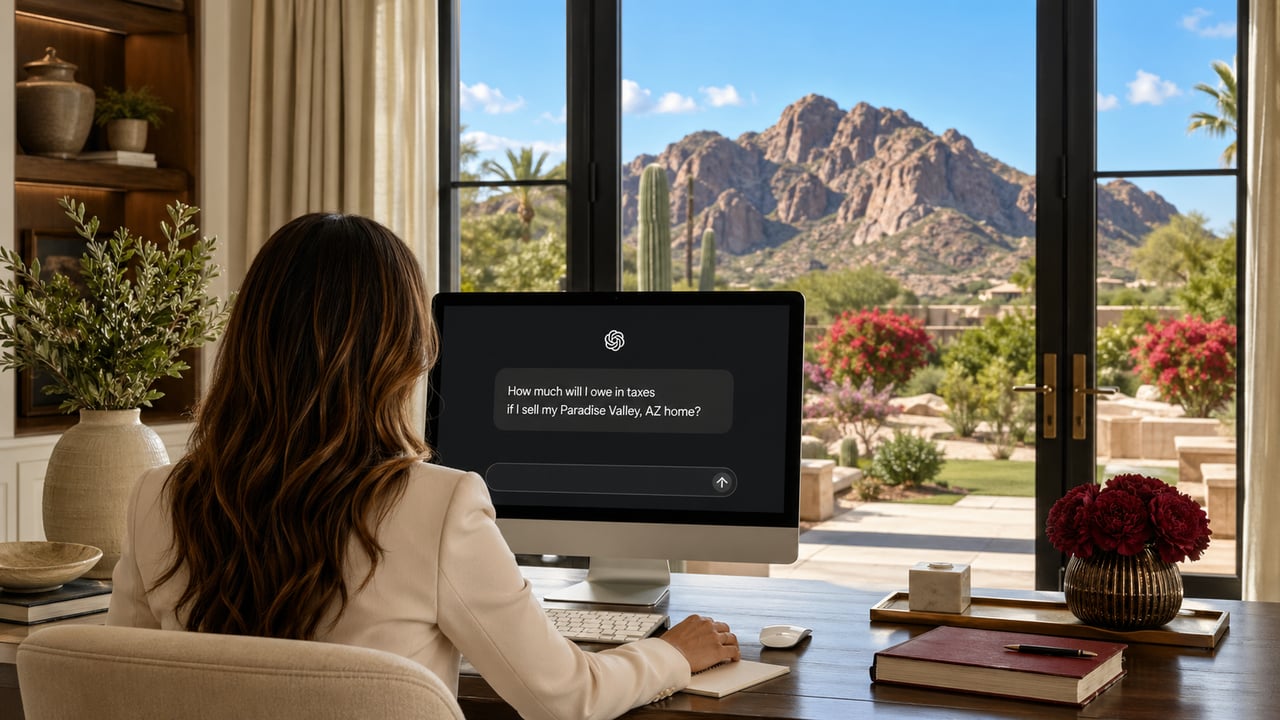
Capital Gains Tax on Your Arizona Home Sale: What Sellers Need to Know in 2026
Selling Resources Krista Becka April 28, 2026
Selling Resources Krista Becka April 28, 2026
Many homeowners who sell their PRIMARY residence don't owe federal capital gains tax because the IRS exclusion shields up to $250,000 in profit for single filers and $500,000 for married couples filing jointly. But if you live in Scottsdale, Paradise Valley, or neighborhoods known for luxury real estate and your home has appreciated significantly, gains above that threshold are taxable.
If you bought your home a decade ago, you've probably done well. Home values across much of Metro Phoenix have more than doubled since 2013. A home purchased for $600,000 in Gainey Ranch or North Scottsdale might be worth $1.3 million or more today. That's a $700,000 gain, and once you subtract the federal exclusion, a meaningful chunk of it may be taxable.
To qualify for the $250,000 in capital gains from the sale of your primary home if you're single, or $500,000 if you're married filing jointly, you must have:
If you meet both criteria, the exclusion applies automatically. But in the luxury market, the exclusion often doesn't reach far enough.
Say you bought a home in Paradise Valley in 2010 for $900,000. You've put $75,000 into improvements over the years. These increases to your cost basis matter. You're selling now for $2.4 million. Your adjusted gain is roughly $1.425 million. After the $500,000 married exclusion, $925,000 is taxable.
One of the best things you can do before you list: pull together documentation of every capital improvement you've made. Every renovation, addition, or major system replacement increases your adjusted basis and reduces your taxable gain. Keep the receipts, and discuss with your CPA before you set a list date.
Arizona taxes capital gains as ordinary income at a flat 2.5% state rate. As of January 1, 2026, the state expanded a 25% long-term capital gains subtraction to apply to all long-term gains, which drops the effective Arizona rate on qualifying gains to approximately 1.875%.
That's meaningfully lower than most states. Arizona also has no state transfer tax unlike California, New York, or most Northeastern states, which is one of several reasons selling here is less costly than sellers coming from those markets often expect.
Arizona SB 1633
The Arizona Senate passed this bill in early 2026 on a 16-12 vote. It would create an unlimited state exemption on home sale gains for sellers who've owned their primary residence for at least five years, meaning zero Arizona state capital gains tax, regardless of how much the home has appreciated.
If it becomes law, the effective date would be 2027.
As of April 2026, SB 1633 still needs to clear the Arizona House and be signed by the governor. It faces political opposition. Critics argue it disproportionately benefits high-income sellers but it has passed one chamber. If you're planning a sale later this year or into 2027, the timing of your closing could matter depending on where this bill lands.
Capital gains tax is one of those costs that's easy to overlook when you're running the mental math on your sale. Most sellers focus on things like the commission, title fees, recording fees, and mortgage payoff. Those costs typically run 8–10% of your sale price in Arizona. But for sellers with substantial gains above the federal exclusion, the tax liability can dwarf every other closing cost combined.
If you're thinking about timing the sale to land in a lower-income year, or modeling what a 2027 close might mean if SB 1633 passes, or simply trying to understand what you'll actually walk away with after everything is settled, that's exactly what a consultation before you list is for. Running the numbers on your specific situation, together, before you're locked into a timeline.
For more on how the time of year affects your sale price and days on market in the Phoenix metro — separate from the tax timing question — this breakdown of Phoenix home sale timing by season is worth a read. And if you're weighing whether a quiet, off-market sale might give you more control over timing and exposure, this post on off-market vs. on-market listing walks through when each approach makes sense.
Do I always have to pay capital gains tax when selling my house in Arizona?
Not necessarily. If your profit falls within the federal exclusion — $250,000 for single filers and $500,000 for married couples filing jointly — you won't owe federal capital gains tax. You'll also likely owe no state capital gains tax since Arizona's rate applies to the same gain. Most sellers in average-priced markets won't owe anything. In Scottsdale and Paradise Valley, where long-time homeowners often have gains well above those thresholds, it's a different conversation.
What's the difference between the federal exclusion and the actual capital gains tax rate?
The exclusion is the portion of your gain that's completely tax-free. Any gain above it is taxable. Federal long-term capital gains tax rates run 0%, 15%, or 20% depending on your income — high earners often face the 20% rate plus a 3.8% Net Investment Income Tax. Arizona's effective rate on long-term gains is approximately 1.875% as of 2026.
What is Arizona SB 1633 and when does it take effect?
SB 1633 is a bill passed by the Arizona Senate in early 2026 that would eliminate state capital gains tax on primary home sales for sellers who've owned their home for at least five years. As of April 2026, it still needs to clear the Arizona House and be signed by the governor. If passed, it would take effect in 2027. It's pending — not law — but worth tracking if you're planning a sale this year or next.
How do home improvements affect my capital gains tax when selling in Arizona?
Improvements increase your cost basis, which reduces your taxable gain. If you bought a home for $800,000 and put $100,000 into renovations, your adjusted basis is $900,000. On a $1.5 million sale, your taxable gain is $600,000 rather than $700,000. Keep records of every capital improvement — they can meaningfully reduce your tax bill.
Should I wait until 2027 to sell if Arizona SB 1633 passes?
That depends on your full financial situation. If your gain above the federal exclusion is substantial, waiting one year could save a meaningful amount in state capital gains tax. But the bill isn't law yet, and your carrying costs, market conditions, and personal timeline all factor in. It's worth modeling both scenarios with your agent and CPA before committing to a list date.
If you're selling a Scottsdale, Arcadia, or Paradise Valley home and want to understand the full picture — not just what you'll list for, but what you'll actually net after every cost including estimated tax exposure — schedule a consultation at kristabecka.com/contact. I'll walk you through a personalized net analysis and help you think through timing so you can make your move with clear eyes.
About Krista Becka
Scottsdale Realtor and Broker Associate Krista Becka helps buyers and sellers across Scottsdale, Arcadia, Paradise Valley, and Greater Phoenix make confident moves. For nearly two decades she's guided move-up buyers and sellers, relocation clients, and investors, protecting equity and helping clients avoid costly mistakes. A seasoned agent with Real Broker, Certified Luxury Home Specialist, REAL Luxury member, and Certified Negotiation Expert, Krista blends data-driven pricing with hyperlocal insight and concierge-level service. Connect with Krista at https://kristabecka.com/contact
Her extensive 15+ year tenure as a full-time agent has seen her navigate the diverse and dynamic markets of Scottsdale, Arcadia, Paradise Valley, and other East Valley cities. Her hands on experience as a property owner and investor in these areas adds a unique perspective to her professional insights.